
filip
June 15, 2026
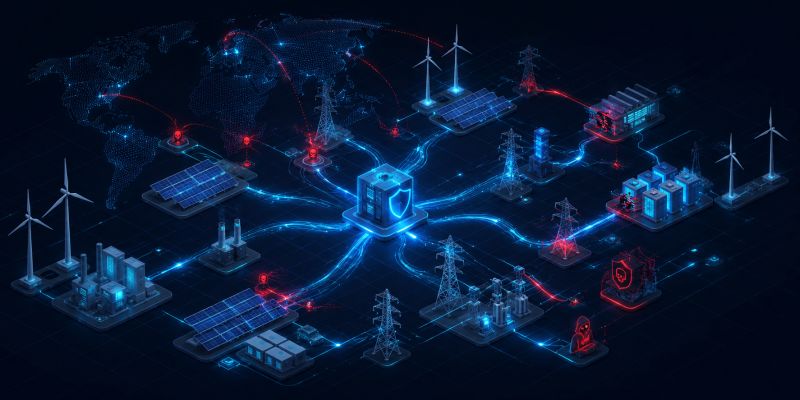
The Evolution of Cyber-Attacks on the Global Power Grid
The flip of a switch is something we take for granted. But over the last decade, the power grid has transformed from a series of mechanical gears into a hyper-connected digital ecosystem. While this makes our energy “smarter,” it has also significantly increased the exposure of utility infrastructure to sophisticated cyber threats.
From the first-of-its-kind blackout in Ukraine to the recent automated sabotage in Poland, the way hackers attack our light and heat has evolved from manual meddling to highly automated and scalable disruption techniques.
1. 2015: The Human Touch (Ukraine)
In December 2015, the world watched as a cyberattack caused a large-scale power outage for the first time in history. This wasn’t a Hollywood-style “instant hack.” It was a slow, patient game.
- The Entry: Simple phishing emails were sent to utility staff. Once inside, hackers spent six months learning the system.
- The Strike: Hackers did not rely on automated malware to operate breakers; instead, they logged in using compromised operator credentials and manually executed switching operations. .
- The “Bricking”: To make sure the lights stayed off, they uploaded malicious software that “bricked” (permanently broke) the hardware and flooded call centers so customers couldn’t report the outage.
2. 2016: The Rise of the Machine (Kyiv)
Just a year later, the tactics shifted. Instead of humans clicking buttons, hackers deployed Industroyer – the first malware designed to “speak” the language of power grids.
It functioned almost like a specialized control interface for substations. It didn’t need a human to navigate the menu; it understood the industrial protocols (like IEC 61850) and could automatically tell the grid to shut itself down. This demonstrated that attackers could develop reusable frameworks capable of targeting multiple grid environments.
3. 2020: Probing the Load Dispatch Centers (Mumbai)
The 2020 incident in Mumbai highlighted a shift toward deep network infiltration of Load Dispatch Centers – the nerve centers that balance electricity supply and demand. Unlike earlier attacks that focused on local substations, this event demonstrated how adversaries could target the administrative IT layers that manage regional power flow.
-
Technical Entry: Researchers found malware that had been “sleeping” inside the network for months. The goal was to silently map out the digital architecture of the management systems without being detected.
-
The Risk of “Data Blindness”: The real danger here is data manipulation. If an attacker can change the numbers an operator sees on their screen, the operator might make a move that causes a “cascading failure”- a chain reaction where the grid shuts itself down to prevent damage based on false information.
4. 2025: Targeting the “Green” Grid (Poland)
As utilities continue integrating renewable energy sources, the grid is becoming increasingly decentralized. Instead of relying on a few large power plants, modern networks now depend on thousands of distributed solar and wind assets connected across wide geographic areas.
This transformation improves flexibility, but also expands the cyber attack surface. Security experts increasingly warn about scenarios where attackers target Grid Connection Points, renewable site controllers, or remote access systems supporting distributed energy resources.
Common vulnerabilities include weak credentials, lack of Multi-Factor Authentication (MFA), and poorly secured remote maintenance access. In such cases, malicious software could disrupt operator visibility, disable remote control capabilities, or even damage equipment during critical operating conditions.
Unlike traditional grid incidents, attacks on decentralized infrastructure may affect dozens of distributed sites simultaneously, making restoration significantly more complex.
The Technical “Arms Race” of 2026
Today, the threat has entered a new phase: AI-driven sabotage. Security researchers are increasingly warning about AI-assisted malware capable of adapting to industrial environments. We are also seeing “Voice Cloning,” where attackers use AI to mimic a supervisor’s voice to trick employees into giving up passwords.
Evolution of Threats (2015–2026)
| Year | Primary Tactic | Level of Automation | Key Consequence |
|---|---|---|---|
| 2015 | Manual remote access | Low (Human-led) | 230,000 people without power |
| 2016 | Protocol-aware malware | Medium (Scripted) | 1/5th of Kyiv goes dark |
| 2020 | Long-dwell probing | High (Stealth) | Monitoring & signaling (Mumbai) |
| 2025 | Decentralized sabotage | High (Automated) | Physical destruction of hardware |
| 2026 | AI-generated attacks | Autonomous | Rapid, targeted “living off the land” |
Conclusion: A New Standard for Safety
The history of these attacks teaches us one vital lesson: the “air-gap” concept (keeping systems offline) is a myth. In a world where hackers can mimic voices and use AI to write custom viruses, “obscurity” is no longer “security.”
For the modern power utility, cybersecurity is no longer just an IT issue, it is a matter of public safety. To keep the heat on in 2026 and beyond, companies must move away from simple passwords and focus on “Internal Monitoring” – watching their own networks as closely as they watch the voltage on the wires.
The boundary between the digital and physical worlds has dissolved. To protect the grid, we must protect the code.
Comments are closed