
filip
July 14, 2026
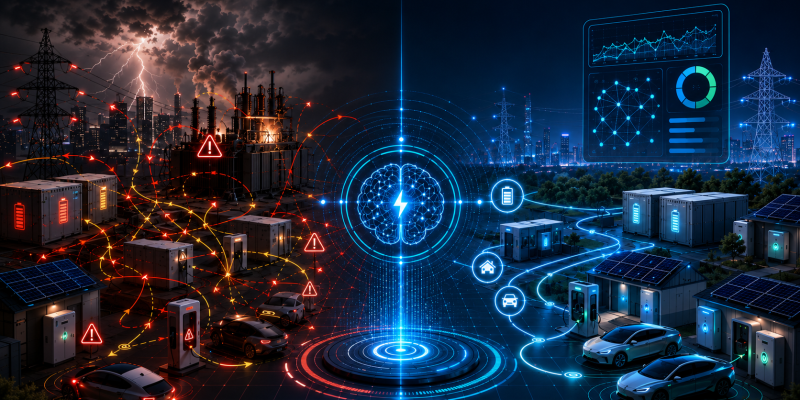
The Evolution of Cyber-Attacks on the Global Power Grid
Think of the modern electrical grid as a massive, high-stakes orchestra. For over a century, it played a simple tune: a few giant power plants (the brass section) blasted electricity in one direction to millions of homes.
Today, the orchestra is changing. We are adding millions of new instruments, specifically, lithium-ion batteries. From massive utility-scale storage facilities batteries are hailed as the ultimate savior of clean energy. They capture excess solar power during the day and discharge it when the sun goes down.
The hook? Batteries add incredible flexibility, but without coordination they can actually add risk to the grid. Here is why simply throwing more batteries at the grid won’t fix our energy challenges, and why the real secret to a safer grid isn’t just hardware, but software.
1. The Nightmare of Dispatch Complexity
In the old days, grid operators only had to turn a few metaphorical knobs to balance supply and demand. If a city needed more power, a coal or gas plant ramped up.
Now, imagine an operator trying to manage a grid with 50,000 decentralized home batteries, 5,000 electric vehicles plugged into chargers, and dozens of regional solar-plus-storage farms. This is the reality of Distributed Energy Resources (DERs).
The sheer dispatch complexity is staggering. Instead of a few knobs, operators are facing a massive control panel with millions of blinking lights. Without an automated way to manage these assets, human operators can quickly become overwhelmed, leading to slow response times during unexpected grid stress or blackouts.
2. The Chaos of Conflicting Signals
Batteries don’t just sit there; they respond to signals. The problem is that different batteries are often listening to different bosses, leading to conflicting signals.
Consider this scenario during a blistering hot summer afternoon:
-
The Economic Signal: A homeowner’s smart battery sees that electricity prices are spiking, so it automatically starts discharging power to the grid to make money for the owner.
-
The Local Grid Signal: Meanwhile, the local substation down the street is already overheating because everyone is running their air conditioners.
If thousands of neighborhood batteries suddenly dump power into an already stressed local circuit at the exact same time, they can overload the transformer. Because the batteries acted on a price signal without knowing the physical limitations of the local grid, their “helpful” injection of clean energy just caused a localized blackout.
Without a centralized referee, thousands of well-intentioned batteries can inadvertently fight each other, creating instability rather than safety.
3. The Conductor: DERMS Orchestration
So, how do we stop the orchestra from turning into a shouting match? The answer is DERMS (Distributed Energy Resource Management Systems).
DERMS is the software brain that acts as the ultimate grid conductor. Instead of letting every battery operate in a vacuum, DERMS provides real-time orchestration.
-
Visibility: It gives grid operators a bird’s-eye view of every single battery connected to the system, knowing exactly how much energy is stored and where.
-
Intelligent Control: DERMS uses advanced algorithms to forecast grid needs and manage the flow of energy. If a local transformer is stressed, DERMS will tell nearby batteries to hold off on discharging, or even absorb excess power, regardless of what the market price is.
-
Safety First: It translates complex, conflicting market and physical signals into a single, cohesive operational plan, ensuring that adding flexibility never comes at the cost of reliability.
The Bottom Line
Batteries are the bricks of the future grid, but DERMS is the mortar holding them together.
We cannot build a safer, more resilient grid simply by buying more hardware. True grid safety in the renewable era won’t be measured by how many megawatts of battery storage we can install, but by how intelligently we can orchestrate them.
What do you think?
Comments are closed